What Credit Score Do You Need to Buy a House in 2026?
The credit score to buy a house depends on the loan program you choose. Many lenders start conventional loans near a 620 credit score, while FHA financing can open the door for scores in the 500s, while conventional, VA, and jumbo loans follow different rules. This guide shows the minimum scores by program, what they mean for your rate and monthly payment, and the specific steps that can move your score higher before you apply.
Saman Khanian
Author
Free credit review with a licensed loan officer · No obligation

620 is the common conventional baseline
FHA may allow 500–579 with a larger down payment
The Short Answer
What Credit Score Is Needed for a Mortgage?
In most cases, the minimum credit score to buy a house with a conventional loan is 620. FHA guidelines allow scores as low as 580 with 3.5% down — or 500–579 with a larger 10% down payment — though individual lenders may set stricter floors. VA loans have no official minimum, but many lenders require 580 or 620. For the credit score to buy a house at higher price points, jumbo lenders typically want 700 or better.
Those numbers are the floor, not the finish line. A 620 score may qualify, but 740 often earns a better interest rate, a more affordable monthly payment, and more room for down payment flexibility and pricing concessions. The rest of this guide breaks down each program, shows what a score change is worth in real dollars, and outlines what you can do before you apply.
Conventional loan
620
Common baseline for many lenders; 3% down programs may require more.
FHA loan
580
3.5% down at 580+; a 10% down option may be available from 500.
VA loan
620
No VA-wide minimum, but most lenders set their own 580–620 floor.
Jumbo loan
700+
Higher reserves and documentation are typical at this level.

What You Will Learn
- The exact minimum scores for FHA, VA, conventional, jumbo, and non-QM loans
- How credit score bands affect your interest rate and monthly payment
- The other factors — income, DTI, down payment, and reserves — that lenders weigh
- A step-by-step plan to raise your score before you apply
- What to do if your score is below the typical threshold
How Lenders Read Your Score
How Different Credit Scores Affect Your Mortgage
Mortgage credit scoring works in bands, not single points. Lenders map your score to a pricing tier and a maximum loan amount, so the difference between a 618 and a 622 can be meaningful — it can decide whether you are eligible for conventional financing at all. The chart below shows the bands most mortgage pricing models use.
Credit Score Bands
Illustrative bandsWidest program access and the most competitive pricing.
Strong conventional and jumbo options; favorable rate tiers.
Most conventional programs available; pricing improves with improvements.
Common conventional floor; FHA is fully available.
FHA 3.5% down path and some VA lenders; conventional is difficult.
FHA with 10% down at select lenders; other programs are unlikely.
Lenders often use the middle score
When you have three credit reports, mortgage lenders typically use the “middle score” — not an average. If your scores are 611, 638, and 652, the 638 is what drives pricing. If there are two borrowers, lenders usually use the lower of each borrower's middle score.
Score matters, but it is not the only factor
A 700 credit score without documented income or with high debt does not guarantee approval. Lenders evaluate your full application — income, debt-to-income ratio, down payment, reserves, and property — alongside your credit profile.
Program by Program
Minimum Credit Score by Loan Type
These are common industry reference points, not a guarantee that a specific lender will approve at a specific score. Lenders can set stricter requirements on top of agency guidelines, and many offer pricing adjustments and additional overlays.
| Loan Program | Typical Minimum Score | Minimum Down Payment | What to Know |
|---|---|---|---|
| Conventional | 620 | As little as 3% | Government-sponsored but not FHA-insured. Stronger credit usually lowers pricing and mortgage insurance costs. 3% down options commonly target first-time buyers with higher scores. Conventional loans |
| FHA | 580 (3.5% down) / 500 (10% down) | 3.5% or 10% | Insured by the Federal Housing Administration. Annual mortgage insurance premiums usually apply for the life of the loan when you put less than 10% down. FHA & VA loans |
| VA | No VA minimum — lender floors vary | 0% for eligible veterans | Available to eligible veterans, active-duty service members, and surviving spouses. Many lenders set their own floors around 580–620. VA loan options |
| Jumbo | 700+ at many lenders | Typically 10%+ | For loan amounts above the conforming limit. Often requires larger reserves, stronger income documentation, and a more rigorous evaluation. Jumbo loans |
| Non-QM | Varies by program | Varies | Alternative programs such as bank statement, DSCR, and asset-based loans may have different credit thresholds — some require 620+, others may be more flexible. Non-QM loans |
Conventional
620Minimum down payment
As little as 3%
Government-sponsored but not FHA-insured. Stronger credit usually lowers pricing and mortgage insurance costs. 3% down options commonly target first-time buyers with higher scores.
Conventional loansFHA
580 (3.5% down) / 500 (10% down)Minimum down payment
3.5% or 10%
Insured by the Federal Housing Administration. Annual mortgage insurance premiums usually apply for the life of the loan when you put less than 10% down.
FHA & VA loansVA
No VA minimum — lender floors varyMinimum down payment
0% for eligible veterans
Available to eligible veterans, active-duty service members, and surviving spouses. Many lenders set their own floors around 580–620.
VA loan optionsJumbo
700+ at many lendersMinimum down payment
Typically 10%+
For loan amounts above the conforming limit. Often requires larger reserves, stronger income documentation, and a more rigorous evaluation.
Jumbo loansNon-QM
Varies by programMinimum down payment
Varies
Alternative programs such as bank statement, DSCR, and asset-based loans may have different credit thresholds — some require 620+, others may be more flexible.
Non-QM loansMinimum scores can change, and no published guideline overrides a lender's own underwriting. The most reliable answer is a pre-approval review based on your actual credit report, income, and savings. Start your application or learn how pre-approval works.
What a Higher Credit Score Saves You
On a $400,000 30-year fixed loan, a stronger credit score can mean a lower rate and a smaller monthly payment. The figures below are hypothetical and for illustration only — your actual rate depends on lender pricing, loan type, down payment, and market conditions.
| Credit Score | Illustrative Rate | Monthly P&I (est.) | Monthly Difference |
|---|---|---|---|
| 760 | 6.25% | $2,462 | Baseline |
| 700 | 6.50% | $2,529 | +$67 / mo |
| 660 | 6.875% | $2,629 | +$167 / mo |
| 620 | 7.25% | $2,728 | +$266 / mo |
Going from a 620 to a 760 score in this example lowers the payment by about $266 a month — roughly $3,192 per year — before considering differences in mortgage insurance. Rates shown are illustrative only and are not a quote or an offer to lend.
The Full Picture
What Else Lenders Consider Besides Your Credit Score
The credit score to buy a house is a threshold, not the whole story. Mortgage underwriting looks at several parts of your financial profile. Understanding them helps you spot where your application is strongest and where you may want to prepare.
Income and employment
Stable, documented income must support the new payment. Self-employed buyers often provide additional documentation, such as tax returns or business financials, depending on the program.
Debt-to-income ratio (DTI)
Lenders compare total monthly debt payments with gross monthly income. A lower DTI signals more room to absorb a mortgage payment.
Down payment and reserves
A larger down payment reduces exposure. Some programs also require proof of cash reserves after closing.
Payment history and tradelines
Recent late payments, collections, or high balances can affect credit even when the score is competitive. A clean recent history matters.
Assets
Down payment, closing costs, and reserve funds are verified. A strong balance sheet can support an application that is marginal on some other front.
Get a full pre-approval review
A licensed loan officer can review your credit, income, and assets together and tell you which programs you are positioned for.
Practical Steps
How to Raise Your Credit Score Before You Apply
If your score is close to a qualifying threshold, a few focused actions can make the difference between a higher-cost and a lower-cost approval. Here is where most borrowers find the most traction.
Pull all three credit reports
Review your reports from Equifax, Experian, and TransUnion. Look for errors such as accounts that are not yours, incorrect balances, or duplicate collections. Disputing inaccuracies with the bureaus is free and can be the quickest way to lift a score.
Pay down revolving balances
Credit utilization — the share of your available credit you are using — is one of the most influential factors in your score. Reducing balances on credit cards often produces a noticeable improvement within one or two billing cycles.
Avoid new credit while your application is active
Opening a new card or auto loan shortly before applying can lower your score and create questions during underwriting. Hold off on new credit until your mortgage closes.
Keep old accounts open
The length of your credit history matters. Closing your oldest card can shorten your history and reduce your available credit, both of which can lower your score.
Stay current on every payment
Payment history is the largest factor in most credit scores. A single missed payment can have a lasting effect, so set up automatic payments where possible.
Talk with a loan officer about timing
Some improvements take weeks; others take months. A loan officer can help you decide whether to apply now with the program available to you, or wait and apply with stronger credit and pricing.
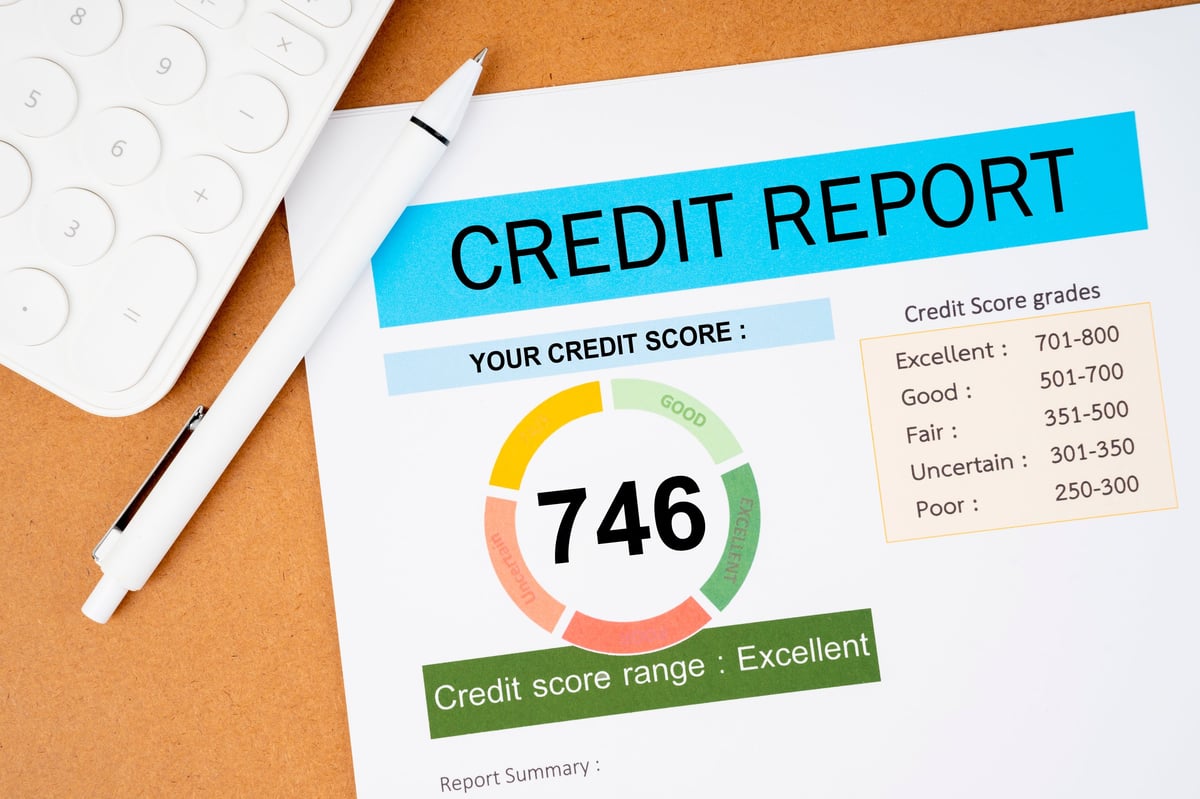
Reviewing all three credit reports is the starting point.
Avoid credit repair myths
- You cannot legally have accurate negative information removed early.
- Closing cards does not erase debt and can hurt your score.
- Paying a collection does not automatically remove it from your report.
- No company can guarantee a specific score increase.
Below the Typical Range
Can You Buy a House With a Lower Credit Score?
Sometimes the credit score to buy a house is lower than you expect. FHA guidelines generally reference a floor in the 500s for borrowers who can make a larger down payment. Some VA lenders also work with scores below 620. Beyond conventional programs, non-QM options — such as bank statement loans for self-employed buyers — may offer different credit requirements depending on the program.
Lower credit usually comes with trade-offs: a higher interest rate, a larger down payment requirement, additional documentation, or stricter pricing adjustments. The best way to know what is available is to have a loan officer review your file and map the options honestly.
- FHA with a larger down payment may still be a realistic path
- Some lenders offer programs for borrowers rebuilding credit
- Bank statement and non-QM loans may suit self-employed buyers
- Pre-approval can show you exactly what you qualify for today

Bring us any other lender's offer
We will work to beat it — Mortgages Made Easy
Frequently Asked Questions About Credit Scores and Mortgages
What is the minimum credit score to buy a house?
Common industry reference points are 620 for conventional loans, 580 for FHA with a 3.5% down payment (and 500–579 with 10% down at some lenders), and no official VA minimum although many lenders require 580–620. Jumbo lenders typically look for 700 or higher. Individual lenders can set stricter requirements than these baselines.
Can I buy a house with a 580 credit score?
Yes, in many cases. A 580 score commonly qualifies for an FHA loan with 3.5% down, and some VA lenders work with scores in that range. Rates and mortgage insurance costs are generally higher than for stronger credit, and a conventional loan is usually difficult at that level.
Can I buy a house with a 600 credit score?
Likely, through FHA rather than conventional financing. FHA lenders commonly accept 580 and above for the 3.5% down option. Conventional programs commonly start at 620, so a 600 score may need a few months of credit improvement for a conventional approval or a non-QM alternative.
Which credit score do lenders use when there are multiple scores?
Mortgage lenders typically use your middle credit score across the three bureaus. With two borrowers, they usually use the lower of the two middle scores. This is why it helps to review all three reports rather than a single score app.
How much can a higher credit score save me?
A stronger score often means a lower interest rate and smaller monthly payment. On a $400,000 loan, moving from an illustrative 7.25% rate to 6.25% lowers the principal-and-interest payment by roughly $266 a month. Actual savings depend on lender pricing, program, and market conditions.
How long does it take to improve a credit score?
Some changes, such as correcting reporting errors or paying down balances, may show up within one or two billing cycles. Others, such as recovering from late payments, can take significantly longer. A loan officer can help you compare applying now versus waiting.
Do I need perfect credit to get a mortgage?
No. There is no single required score, and different programs serve different credit profiles. What matters is matching your score, income, down payment, and debt to a program that fits. Pre-approval shows what you qualify for based on your full file.
Written by
Saman Khanian
Saman Khanian writes about residential lending for Equitable Lending, a Los Angeles-based mortgage lender offering conventional, FHA, VA, jumbo, non-QM, and investor financing. Equitable Lending is licensed under NMLS #1124483 and DRE #01941713.
Disclaimer: This article is educational and is not a loan offer, commitment, or guarantee of approval. There is no guaranteed credit score for approval. Loan eligibility, rates, fees, mortgage insurance, loan limits, and program requirements depend on lender and agency guidelines and each borrower's individual qualifications, and may change. Figures are illustrative estimates only and exclude taxes, homeowners insurance, and other costs unless stated. Visit our Disclosures and Licensing Information pages. Equal Housing Opportunity.
Ready to Learn What Your Credit Score Qualifies For?
Talk with a licensed loan officer at Equitable Lending about the credit score to buy a house in your situation. Bring us any other lender's offer — we will work to beat it.
NMLS #1124483 · DRE #01941713 · 2824 South Robertson Blvd, Los Angeles, CA 90034